

Online Roulette: Rules, Bets and the Mathematics of the Wheel
Roulette is one of the simplest casino games to understand, yet the wheel, betting layout and payout rules reveal a surprisingly interesting mathematical story.
A small ball spins around a numbered wheel. Players place their wagers before the betting period closes, and the outcome is determined by the pocket in which the ball eventually settles.
Unlike blackjack, roulette offers no opportunity to hit, stand or change the result once a valid bet has been placed.
But not every roulette game is mathematically identical.
European roulette has one zero, American roulette has two, and some French roulette tables offer special rules that can reduce the theoretical house edge on certain bets.
There are also differences in table layouts, betting options, minimum stakes and the way online roulette games are presented.
At Spins247.com, we have followed the online casino industry since 2002. Over the years, roulette has developed from relatively basic digital wheels into a category featuring automated games, live dealer tables and numerous variations.
In this guide, we explain the rules, examine the different types of roulette bets and explore the mathematical differences between the most familiar versions.
We also look at hot and cold numbers, betting systems and why previous spins cannot reliably predict the next result.
How to Play Roulette Online
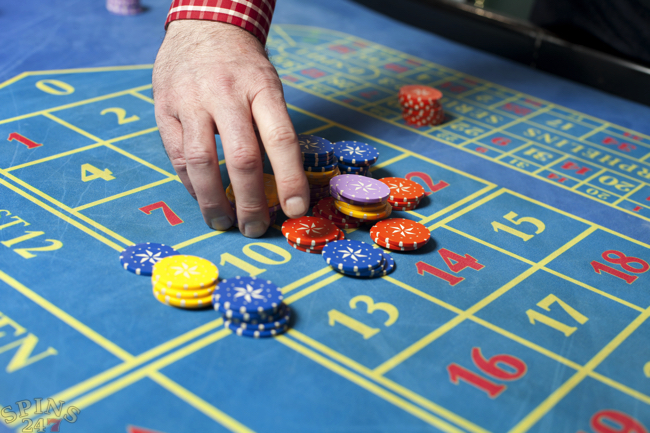
Roulette is played using a numbered wheel, a ball and a betting layout representing the available wagers.
Before each spin, players select the outcomes they wish to bet on and choose how much to wager.
The betting period closes before the final outcome is known.
In a traditional physical game, the dealer spins the wheel and launches the ball in the opposite direction. The ball eventually falls into one of the numbered pockets.
In a digital roulette game, the result is normally generated by software using a random number generator.
The Roulette Numbers
The standard numbered section runs from 1 to 36.
Half of these numbers are red and half are black. The zero pocket is green, as is double zero where present.
The numbers are arranged around the wheel in a deliberately non-sequential order.
Placing a Bet
Players can wager on individual numbers, groups of numbers or broader categories such as red, black, odd, even, high or low.
Different wagers have different probabilities of winning and different payouts.
Winning and Losing
Once the result is determined, winning bets are settled according to the published payout table.
Most losing wagers are collected, although special rules such as La Partage or En Prison can change the treatment of certain even-money bets when zero appears.
The central principle is straightforward: a winning bet must cover the number on which the ball lands.
18 black pockets
1 green zero
18 black pockets
2 green pockets: 0 and 00
European, American, French and English Roulette
The most important distinction between roulette variations is the wheel configuration and the rules used to settle bets.
However, some names describe the style of the table or the presentation rather than an entirely different mathematical game.
European Roulette
European roulette uses a wheel with 37 pockets, including a single zero.
On standard bets, the theoretical house edge is approximately 2.70%.
This is one of the most familiar roulette formats in both online and land-based casinos.
American Roulette
American roulette uses 38 pockets, adding double zero to the wheel.
Most standard bets have a house edge of approximately 5.26%.
The five-number bet covering 0, 00, 1, 2 and 3 is a notable exception, with a higher house edge of approximately 7.89% under the standard 6:1 payout.
French Roulette
French roulette normally uses a single-zero wheel, often accompanied by French terminology and a different betting layout.
Some versions offer La Partage or En Prison rules, which can improve the theoretical return on qualifying even-money wagers.
However, these rules should not be assumed to apply to every game labelled French Roulette.
English Roulette
English Roulette is a name sometimes used for a particular table presentation or traditional casino format.
It may involve coloured chips assigned to individual players and other table-management conventions.
Unlike European and American roulette, the name alone does not identify a universally distinct wheel configuration or house edge.
The actual rules and number of pockets must therefore be checked.
Roulette Pro and Other Digital Variants
Some digital roulette games include statistics, favourite-bet functions, special betting layouts or additional interface features.
These functions can change the playing experience, but they do not necessarily change the mathematical probabilities.
Games with multipliers, altered payouts or additional special features require separate analysis because their rules may differ from conventional roulette.
| Variation | Wheel | Standard House Edge |
|---|---|---|
| European | Single zero | 2.70% |
| American | Double zero | 5.26%* |
| French | Usually single zero | 2.70% or 1.35% on qualifying bets |
| English | Check specific rules | Depends on wheel and payouts |
Inside Roulette Bets: Individual Numbers and Small Groups
Inside bets are placed on the numbered section of the roulette layout.
They generally cover fewer numbers than outside bets and therefore offer larger payouts when successful.
Straight-Up Bet
A straight-up bet covers one individual number.
In standard roulette, a winning straight-up wager pays 35:1 in net profit.
Split Bet
A split bet covers two adjacent numbers on the betting layout.
The standard payout is 17:1.
Street Bet
A street bet covers three numbers in the same horizontal row of the layout.
The standard payout is 11:1.
Corner Bet
A corner bet covers four numbers meeting at the same intersection.
The standard payout is 8:1.
Six-Line Bet
A six-line bet covers six numbers across two adjacent rows.
The standard payout is 5:1.
Why Higher Payouts Do Not Mean Better Odds
A straight-up bet pays more than a six-line bet because it has a lower probability of winning.
Under conventional European roulette rules, these standard wagers have the same theoretical house edge despite their different probabilities and payouts.
The distinction is between the frequency of winning and the long-run expected return.
| Bet | Numbers Covered | Net Payout |
|---|---|---|
| Straight Up | 1 | 35:1 |
| Split | 2 | 17:1 |
| Street | 3 | 11:1 |
| Corner | 4 | 8:1 |
| Six Line | 6 | 5:1 |
Outside Roulette Bets: Red, Black, Odd, Even and More
Outside bets cover larger groups of numbers and are placed around the main numbered section of the betting layout.
They generally win more frequently than inside bets, but the payouts are correspondingly smaller.
Red or Black
Players wager on whether the winning number will be red or black.
Each colour covers 18 numbers on a standard roulette wheel.
The payout is 1:1.
Odd or Even
These wagers cover the 18 odd or 18 even numbers between 1 and 36.
Zero and double zero, where applicable, do not count as even numbers for standard roulette betting purposes.
High or Low
Low covers numbers 1–18, while high covers numbers 19–36.
Both wagers normally pay 1:1.
Dozens
Dozen bets cover 1–12, 13–24 or 25–36.
Each dozen contains 12 numbers and normally pays 2:1.
Columns
Column bets cover one of the three vertical columns of numbers on the betting layout.
Each column contains 12 numbers and normally pays 2:1.
Are Outside Bets Safer?
Outside bets may produce more frequent wins, but this does not automatically mean they have a lower house edge.
On a conventional European roulette wheel, the standard house edge remains approximately 2.70% for both inside and outside bets, unless special settlement rules apply.
| Bet | Numbers Covered | Net Payout |
|---|---|---|
| Red / Black | 18 | 1:1 |
| Odd / Even | 18 | 1:1 |
| High / Low | 18 | 1:1 |
| Dozen | 12 | 2:1 |
| Column | 12 | 2:1 |
French Roulette Call Bets and Wheel Sections
Some roulette tables offer special bets based on the physical arrangement of numbers around the wheel rather than their position on the standard betting layout.
These are often associated with French roulette and may be called announced bets or call bets.
Voisins du Zéro
Voisins du Zéro means neighbours of zero.
It covers a group of 17 numbers around the zero section of a European roulette wheel.
The traditional arrangement uses nine chips distributed across several split, corner and other bets.
Tiers du Cylindre
Tiers du Cylindre covers 12 numbers on the opposite side of the wheel from the zero section.
The traditional arrangement uses six split bets.
Orphelins
Orphelins, or orphans, covers eight numbers not included in the Voisins du Zéro or Tiers du Cylindre groups.
The standard arrangement typically uses five chips.
Jeu Zéro
Jeu Zéro covers seven numbers around zero on the European wheel using a compact four-chip arrangement.
Do Call Bets Change the House Edge?
Under standard single-zero roulette payouts, these arrangements do not remove the underlying house advantage.
They simply distribute wagers across particular wheel sectors.
Each arrangement may involve several chips, so the total amount wagered should be considered rather than focusing on the payout of a single winning component.
The availability and exact chip placement of call bets vary between casino interfaces.
| French Term | Meaning |
|---|---|
| Rouge / Noir | Red / Black |
| Pair / Impair | Even / Odd |
| Manque / Passe | 1–18 / 19–36 |
| Voisins du Zéro | Neighbours of zero |
| Tiers du Cylindre | A section covering 12 wheel numbers |
| Orphelins | Numbers outside the two main wheel sectors |
La Partage and En Prison: When Zero Does Not Mean a Full Loss
Two special rules are particularly relevant when comparing French and European roulette tables.
Both concern the treatment of qualifying even-money bets when the ball lands on zero.
La Partage
Under La Partage, a qualifying even-money wager loses only half its value when the ball lands on zero.
For example, if you wager $20 on red and the result is zero, $10 is returned and $10 is lost.
This reduces the theoretical house edge on qualifying even-money bets from approximately 2.70% to 1.35% on a single-zero wheel.
En Prison
En Prison is another rule used at some French roulette tables.
When zero appears, a qualifying even-money wager may remain on the table for a subsequent spin rather than being immediately settled as a full loss.
The exact outcome depends on the table's version of the rule, including how repeated zeros are treated.
Under a common single-imprisonment version, the theoretical house edge on qualifying even-money bets is approximately 1.35%.
Not All Bets Qualify
These rules generally apply to even-money wagers such as red/black, odd/even and high/low.
They should not be assumed to apply to straight-up, split, street, dozen or column bets.
Always check the actual game rules rather than relying on the roulette variant's name alone.
Hot and Cold Roulette Numbers: Can Previous Spins Predict the Next?
Many online roulette games display recent results, frequently appearing numbers and numbers that have not appeared for some time.
These features are often described as hot and cold statistics.
A hot number is one that has appeared relatively frequently during a selected period. A cold number is one that has appeared less frequently.
Why the Statistics Are Interesting
Roulette results can form noticeable patterns over short periods.
A particular number might appear several times within a small sample, while another number may remain absent for dozens of spins.
These patterns can be interesting to observe, but they do not automatically provide predictive information.
Independent Roulette Spins
In a properly functioning roulette game with independent outcomes, the result of one spin does not determine the next.
On a fair European roulette wheel, every individual number has a probability of 1/37 on each spin.
A number that has not appeared for 50 spins is not mathematically overdue.
The Gambler's Fallacy
The belief that a particular result becomes more likely simply because it has not appeared recently is known as the gambler's fallacy.
For example, ten consecutive red results do not make black more likely than red on the next independent spin.
Both colours still cover 18 of the 37 pockets on a European wheel.
What About Physical Wheel Bias?
Historically, some roulette discussions have examined whether mechanical imperfections can create non-uniform outcomes.
Such effects should not be confused with ordinary hot and cold statistics.
Modern regulated roulette games are expected to operate under applicable fairness and testing requirements, and a short history of results is not reliable evidence of a physical bias.
Roulette Betting Systems, Live Tables and Modern Game Formats
Roulette has inspired numerous betting systems, from simple fixed-stake approaches to complex numerical progressions.
These methods can change how much money is wagered during a session, but they do not change the probability of a particular outcome on an independent spin.
Martingale
The Martingale system doubles the wager after a loss, usually on an even-money outcome such as red or black.
Its apparent simplicity hides an important limitation: the required wager increases rapidly during losing streaks.
Neither the player's available funds nor the table's maximum betting limit is unlimited.
Labouchere
Labouchere uses a sequence of numbers to determine the size of subsequent wagers.
Although its progression differs from Martingale, it cannot remove the house edge of the underlying roulette game.
Fixed-Stake Betting
Flat betting means wagering the same amount on each selected round.
It avoids the exponential stake increases associated with some progression systems, but the house edge remains unchanged.
Live Dealer Roulette
Live roulette uses a physical wheel operated in a streamed casino studio or other suitable gaming environment.
Players place bets through an online interface while watching the spin.
The game may feature different table limits, betting timers and camera angles.
Automated Roulette
Automated roulette can use a physical wheel with mechanical ball-launching equipment or a digital result generated by software, depending on the product.
These formats should not be assumed to be identical simply because they are presented as online roulette.
Multiplier Roulette
Some modern roulette variants introduce random multipliers or modified payout structures.
Such features may change volatility and the theoretical return, so the game-specific rules should be examined separately.
For a deeper examination of roulette betting systems and expected value, read Living on the Edge: The Mathematics Behind Casino Table Games.
Our live casino guide explains more about streamed casino games and live dealer technology.
Frequently Asked Questions About Online Roulette
What is the difference between European and American roulette?
European roulette has one zero and 37 pockets. American roulette has zero and double zero, giving it 38 pockets and a higher house edge on most standard bets.
What is the best roulette bet?
There is no guaranteed winning bet. On conventional European roulette, standard inside and outside wagers have the same theoretical house edge. Qualifying even-money bets under La Partage may offer a lower house edge.
Does red have a 50% chance of winning?
No. On a European roulette wheel, red covers 18 of 37 pockets, giving it a probability of approximately 48.65% on each fair, independent spin.
Can hot and cold numbers predict roulette?
Not in a properly functioning game with independent outcomes. Recent results do not make a particular number more or less likely on the next spin.
What is La Partage?
La Partage is a rule under which qualifying even-money bets lose only half their value when the result is zero. On a single-zero wheel, this reduces the theoretical house edge on those bets to approximately 1.35%.
Can the Martingale system beat roulette?
No. Doubling bets after losses does not change roulette probabilities or payouts. The required stakes can increase rapidly during losing sequences.
Is live roulette more favourable than digital roulette?
Not automatically. The house edge depends on the wheel configuration, payouts and settlement rules, not simply on whether the result comes from a physical wheel or digital software.
